
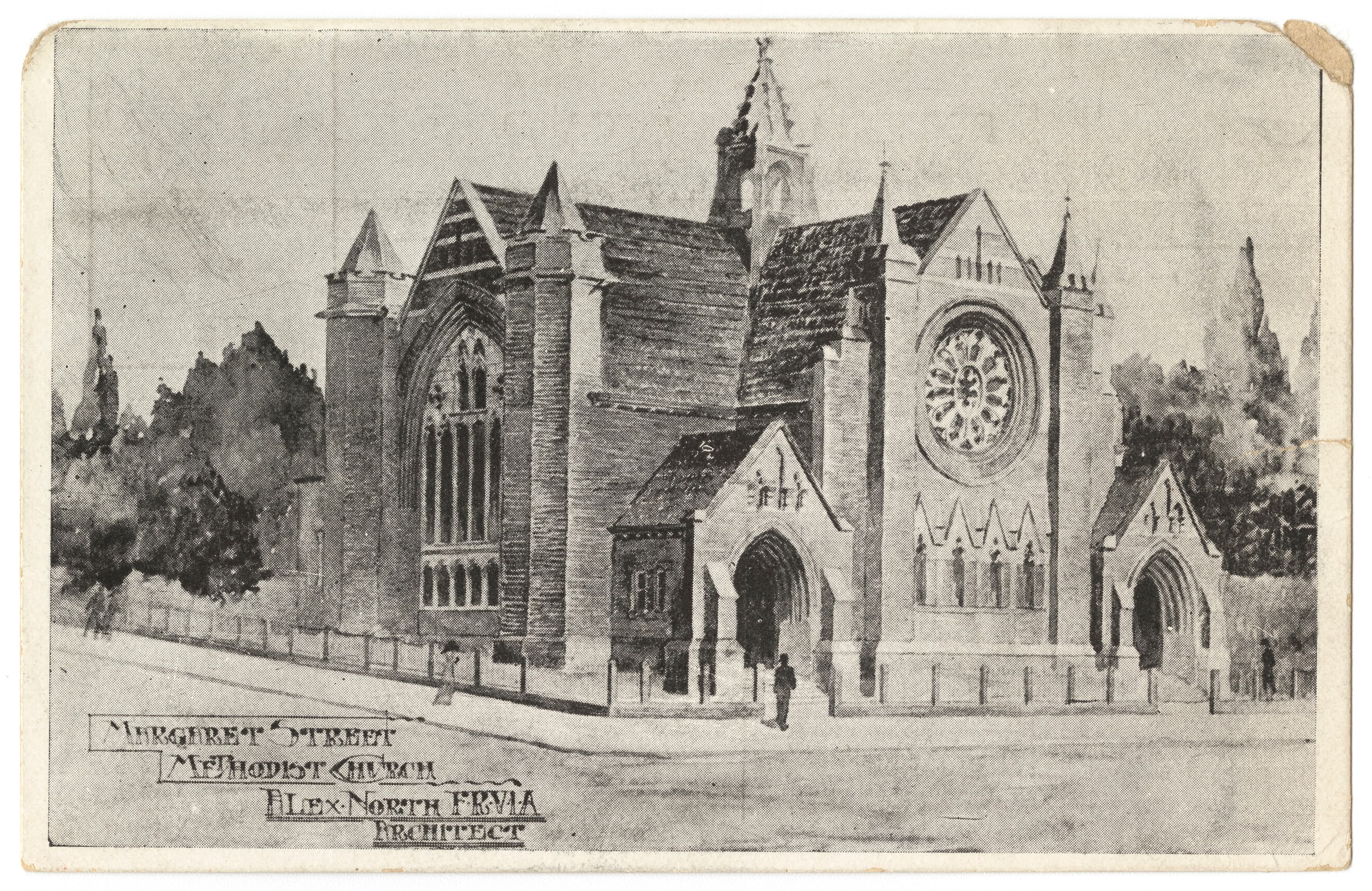
Trinity Uniting (Margaret Street Methodist)
Launceston, Tasmania
Below is part of an article which appeared in the Examiner newspaper in 1939: How Margaret St. Methodist Church was Established Following the definite growth of Launceston, especially in...
- Denomination
- Uniting Wesleyan Methodist
- Region
- North
- Year Built
- 1836
- Architectural Style
- Church
- Heritage Status
- Heritage listed
Overview
Below is part of an article which appeared in the Examiner newspaper in 1939:
How Margaret St. Methodist Church was Established
Following the definite growth of Launceston, especially in the southern end of the town, the Wesleyan's, as they were then called, could see the need for a Chapel in that area. At the time Paterson Street Chapel was already established, but this was the only Wesleyan Chapel in Launceston.
A very active Wesleyan, Mr. Isaac Sherwin, lived in the southern end of the town and was most anxious to see the cause extended, so generously donated a block of land for the purpose of erecting a chapel in Margaret Street. This piece of land is where the present Methodist school hall stands. By this block of land a little stream used to flow - a stream that is unknown to the younger generation, but is clearly recalled by old identities.
The Launceston Circuit Quarterly Meeting convened on the 7th of May, 1836, marked a pivotal moment in the congregation's aspirations. Within this gathering, a resounding desire emerged to establish a dedicated place of worship in the southern precincts of the town. This sentiment, fueled by fervent commitment, catalyzed a series of deliberations that would shape the course of religious infrastructure in the burgeoning community.
By June of 1836, the steadfast resolve of the congregation crystallized into a definitive decision: to erect a chapel, the cornerstone of spiritual communion, at an estimated cost of five hundred pounds. This endeavor found tangible manifestation upon land generously donated by Mr. Isaac Sherwin, a gesture emblematic of communal solidarity and shared spiritual vision.
The subsequent decades bore witness to the evolution of this sacred edifice. Twenty years hence, the initial structure underwent enlargement, a testament to the enduring vitality and expanding membership of the congregation.
Against the backdrop of this architectural metamorphosis, the contours of the Launceston Circuit's landscape began to delineate more distinctly. Notably, in January of 1837, under the stewardship of Rev. J.A. Manton, Margaret Street made its inaugural appearance on the circuit's blueprint, signaling a geographical expansion reflective of the congregation's burgeoning reach and spiritual footprint.
In the local religious community, 27th August 1837, stands as a significant milestone marked by the inauguration of the Sunday-school, serving as a satellite branch of the venerable Paterson Street congregation. Mr. Henry Reed assumed the mantle of Superintendent, spearheading the school's early endeavors. Swiftly gaining traction, the school ascended to prominence within the circuit, emerging as a cornerstone of educational and spiritual nurturing.
By the dawn of the 20th century, the Sunday-school had matured into an institution of distinct identity, embodying the ethos of its founding principles and fostering a legacy of scholastic excellence and moral fortitude.
In the early decades of its existence, services convened in the afternoon, echoing the rhythms of daily life and communal worship. However, as the congregation swelled in numbers and fervor, the demand for evening services became pronounced. In 1878, a pivotal shift occurred as evening services supplanted their afternoon counterparts, reflecting the evolving dynamics of worship and communal engagement.
The burgeoning attendance figures bore testament to the vitality of the congregation, prompting deliberations for the construction of a new edifice. A testament to communal resolve and collective vision, the foundation stone for this new sanctuary was ceremoniously laid on January 3, 1889, under the auspices of the Honorable W. Hart, M.L.C. The fruits of this endeavor manifested swiftly, as the doors of the new sanctuary swung open on June 23 of the same year, heralding a new chapter in the congregation's spiritual journey. Remarkably, the new sanctuary emerged debt-free, a testament to the collective sacrifices and unwavering commitment of the faithful.
Meanwhile, the old structure found renewed purpose as an infant school, embodying the ethos of continuity and adaptation that characterized the congregation's journey through the annals of time.
In 1917 Margaret Street, Lawrence Vale and Hadspen formed a circuit.
In the tapestry of Margaret Street Church's history, the threads of generosity, innovation, and community engagement are woven together to create a rich narrative of resilience and growth.
An emblem of this spirit of generosity, an organ, formerly belonging to Paterson Street, found a new home within the hallowed walls of Margaret Street Church, courtesy of the benevolence of Mr. and Mrs. J.H. Hart. This gift symbolized not only the harmonious exchange between congregations but also the enduring legacy of communal support and collaboration.
The ethos of communal support found further expression with the advent of pledged-giving in 1957, marking a watershed moment in the church's financial stewardship. This innovative practice empowered the congregation to fulfill its sacred mission and bolster its vital role within the community.
In 1964, the acquisition of a new parsonage underscored the church's commitment to providing a nurturing environment for its minister, ensuring their ability to serve the congregation with diligence and devotion.
The year 1970 heralded a subtle yet significant shift in worship practices, as the congregation embraced a transition to a single morning service— a departure from the longstanding tradition of dual services. This evolution reflected the church's responsiveness to changing societal dynamics while remaining rooted in its core values and principles.
Throughout its storied history, Margaret Street Church has served as a crucible for leadership and community engagement, nurturing individuals who have ascended to positions of prominence within both the church and the wider community. Moreover, the vibrant tapestry of church organizations continues to thrive, providing avenues for fellowship, service, and spiritual growth. The revival of the church library stands as a testament to the enduring relevance of knowledge and learning within the church community, serving as a beacon of enlightenment and inspiration for generations to come.
This building is now privately owned, with part now private apartments.
History
June 1836
Decision made to erect the Margaret Street chapel
built1836-05-07
Launceston Circuit Meeting decided to establish a chapel in Margaret Street
founded1837-08-27
Sunday-school inaugurated
openedJanuary 1837
Margaret Street first appeared on the Launceston Circuit plan
1878
Evening services replaced afternoon services
1889-01-03
Foundation stone laid for the new sanctuary
built1889-06-23
New sanctuary opened
opened1917
Margaret Street, Lawrence Vale and Hadspen formed a circuit
1957
Pledged-giving introduced
1964
New parsonage acquired
purchased1970
Church shifted to a single morning service
Gallery
References
- Methodist Church of Australia, Tasmanian Methodism 1820-1975, Methodist Church of Australasia, Launceston, 1975, p. 39Tasmanian Pictorial Church Index
- The Weekly Courier newspaper, 13 Jun 1918, p. 20, photograph Robinson Bros.Tasmanian Pictorial Church Index
- Lucy Stone, The Examiner Newspaper, 17 Feb 2018, p. 13Tasmanian Pictorial Church Index
Links
- Tasmanian Archives, LPIC147/2/203, Photograph - Postcard - Margaret Street Methodist Church, interior - Launceston. Architect, Alexander North - Launceston Architect, Alexander North, Launceston Collection of Photographs, laces, Events, Buildings and General Subjects (LPIC147)
Tasmanian Pictorial Church Index
- How Margaret - St. Methodist Church was Established (1939, July 22). Examiner (Launceston, Tas.: 1900-1954), p. 2. Retrieved October 02, 2019
Tasmanian Pictorial Church Index
- Launceston Collection of Photographs, laces, Events, Buildings and General Subjects (LPIC147)
Tasmanian Pictorial Church Index
- realestate.com.au
Tasmanian Pictorial Church Index
Services
Privately owed
Open
Not recorded
Address
96 Margaret Street, Launceston TAS 7250
Contact
Not recorded
Accessibility
Not recorded


