St David's Cathedral
Hobart, Tasmania
From the pivotal date of 30th June 1812, Hobart Town ascended to the esteemed position of serving as the administrative epicenter for the entirety of Van Diemen's Land, albeit retaining its...
- Denomination
- Anglican
- Region
- South
- Year Built
- 1817
- Architectural Style
- Church
- Heritage Status
- Heritage listed
Overview
From the pivotal date of 30th June 1812, Hobart Town ascended to the esteemed position of serving as the administrative epicenter for the entirety of Van Diemen's Land, albeit retaining its subordination to the overarching authority of New South Wales.
In the ensuing months, against the backdrop of this burgeoning governmental hub, Lieutenant Governor Thomas Davey embarked upon the ambitious endeavor of establishing a spiritual cornerstone in the form of St. David's Church. However, amidst competing priorities such as the imperative construction of Military Barracks and a Colonial Hospital, the fruition of this ecclesiastical vision encountered substantial delays.
It was not until 19th February 1817, that the seminal moment arrived, marked by the ceremonial laying of the foundation stone for St. David's Church. Positioned at the intersection of Murray and Macquarie Streets, this symbolic act was performed by none other than Thomas Davey himself, in homage to the memory of the late David Collins, a figure of historical significance.
The subsequent phases of construction unfolded over a protracted period, beset by logistical challenges and resource constraints. However, perseverance prevailed, and on 9th January 1823, St. David's Church was solemnly consecrated. This auspicious occasion was graced by the esteemed presence of Reverend Samuel Marsden, Senior Chaplain of New South Wales, acting under the auspices of the Archbishop of Canterbury, who bestowed his benediction upon this newfound sanctuary in the burgeoning township of Hobart.
The Hobart Town Gazette and Southern Reporter newspaper in September 1820 announced the following:
*
*
*
*
GOVERNMENT AND GENERAL ORDER - Government House, Hobart Town, Saturday, September 23rd 1820. - The Lieutenant Governor directs that the NEW CHURCH of Hobart Town shall be called 'St. David's Church, : out of respect to the memory of Colonel David Collins, of the Royal Marines, under whole direction the settlement was founded in the year 1804, and who died, Lieutenant Governor, in the year 1810.
Following the tenure of Robert Knopwood, Reverend William Bedford assumed the chaplaincy of the church, overseeing a period marked by significant structural transformations. On 7th January 1835, concerns regarding the stability of the church's steeple prompted its removal. In its stead, the iconic Pepper Pot tower emerged, inaugurated on 18th March 1835, altering the architectural skyline of the burgeoning settlement.
The ecclesiastical landscape continued to evolve with the appointment of Reverend William Hutchins as the inaugural Archdeacon of Van Diemen's Land in 1836, a position he held until his passing in 1841. Reverend Hutchins' legacy was perpetuated through the founding of the Hutchins School in 1846, serving as a testament to his enduring influence.
On 21st August 1842, a seminal moment unfolded with the issuance of Letters Patent by Queen Victoria, appointing Reverend Francis Russell Nixon as the inaugural Bishop of Tasmania. This landmark event heralded the elevation of Hobart Town to city status, concurrently designating St David's Church as St David's Cathedral, signifying its heightened ecclesiastical prominence.
The formal enthronement of Bishop Nixon transpired on 27th July 1843, within the hallowed confines of the old St David's Cathedral, presided over by Senior Chaplain Dr. William Bedford. Subsequently, on 17th January 1862, a significant transfer of property occurred, as the Crown bestowed the land encompassing St David's Cathedral upon the Trustees of the Diocese of Tasmania.
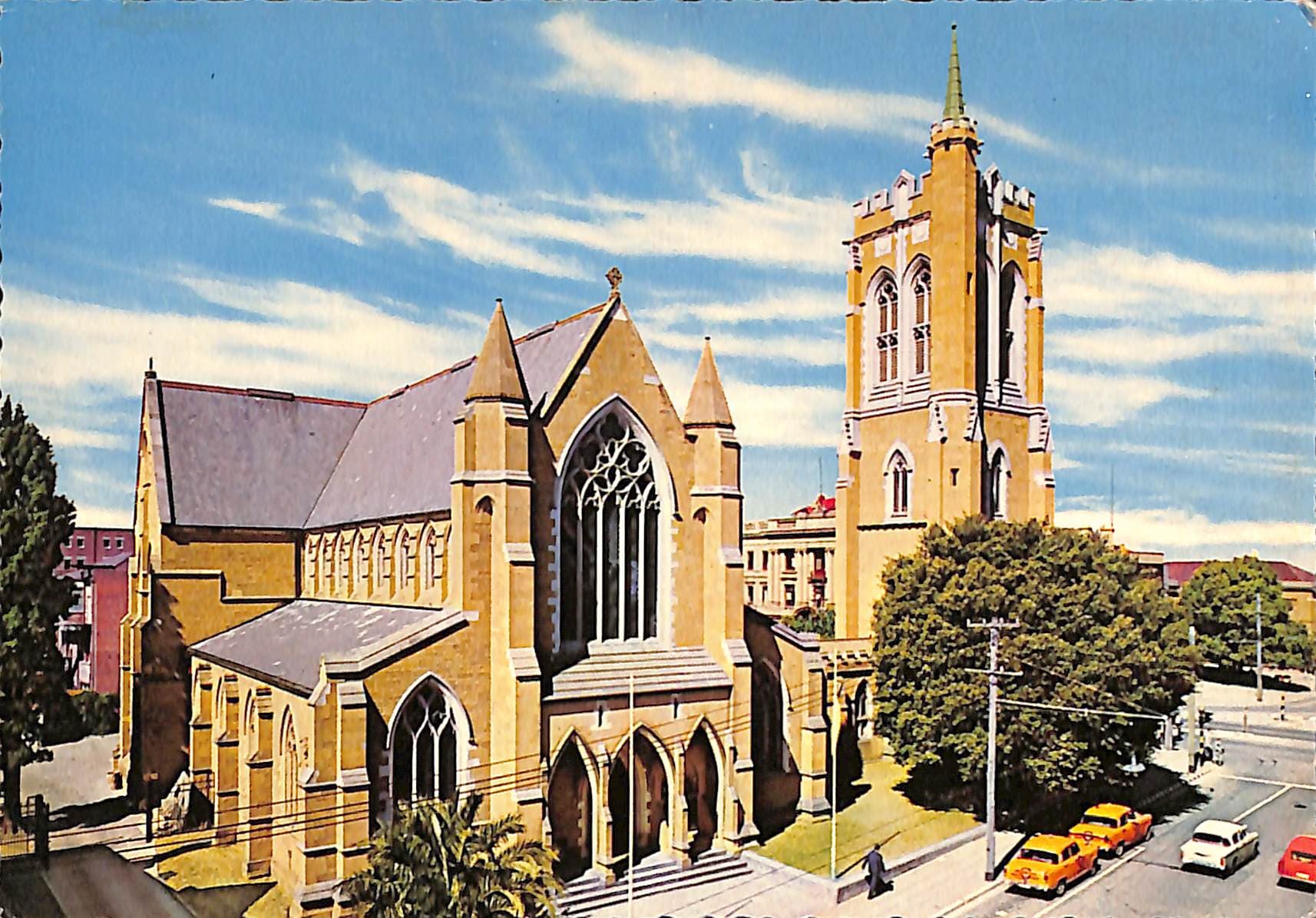
The architectural destiny of St David's Cathedral underwent a transformative phase with the commissioning of George Frederick Bodley as the design architect for its reconstruction. Despite never setting foot on the Hobart site, Bodley's visionary contributions left an indelible imprint on the cathedral's design ethos.
On 8th January 1868, a momentous ceremony unfolded with the laying of the foundation stone for the current iteration of St David's Cathedral by HRH Prince Alfred, Duke of Edinburgh. Supervised by architect Henry Hunter and builder James Gregory, the cathedral gradually assumed its resplendent form, culminating in the consecration of its nave on 3rd February 1874, by Bishop Bromby.
The subsequent decades witnessed a concerted effort towards the cathedral's enhancement and preservation. In August 1908, the reconstruction of the Chancel commenced, a project completed in April 1909, reaffirming the cathedral's architectural integrity.
A pivotal chapter unfolded in 1929 with the commencement of the tower's construction, propelled by a generous anonymous legacy. Under the meticulous oversight of architect Alan Walker and contractor H.W. Pease, the tower and cloisters gradually took shape, with their unveiling and consecration on 1st March 1931, marking a joyous milestone in the cathedral's journey.
The crowning achievement arrived on 28th October 1936, with the completion of the Bell Tower, a testament to the enduring legacy of George Frederick Bodley's vision. This monumental achievement, realized after 68 years of dedicated endeavor, stands as a testament to the unwavering commitment to St David's Cathedral's preservation and perpetuation.
The Cathedral Chambers, recognized on the Tasmanian Heritage Register, as a remarkable example of Victorian Free Gothic architecture, reflecting the stylistic and structural principles that defined the era. This two-story sandstone building embodies the distinct characteristics of the period, with its pointed arches, intricate detailing, and robust masonry construction. Its inclusion in the Heritage Register underscores its historical and architectural significance, serving as a testament to the craftsmanship and aesthetic ideals that shaped Tasmania's built environment in the 19th century.
History
19th century
Cathedral Chambers entered on the Tasmanian Heritage Register
heritage listed1804
Settlement founded under Colonel David Collins
founded1817-02-19
Foundation stone laid for St. David's Church
built1820-09-23
St. David's Church named
1823-01-09
St. David's Church consecrated
consecrated1835-03-18
Pepper Pot tower inaugurated
opened1835-01-07
Steeple removed
demolished1842-08-21
St David's Church became St David's Cathedral
1843-07-27
Bishop Nixon enthroned
1846
Hutchins School founded
founded1862-01-17
Land containing the cathedral transferred to diocesan trustees
transferred1868-01-08
Foundation stone laid for the current St David's Cathedral
built1874-02-03
Nave of St David's Cathedral consecrated
consecratedAugust 1908
Chancel reconstruction began
rebuiltApril 1909
Chancel reconstruction completed
completed1929
Construction of the tower began
built1931-03-01
Tower and cloisters unveiled and consecrated
opened1936-10-28
Bell Tower completed
completed
Gallery
References
- Anglican Church Licenses, NS3613/1/1, pp. 322-3234, Tasmanian ArchivesTasmanian Pictorial Church Index
- Church News, January 1957Tasmanian Pictorial Church Index
- The Tasmanian Mail newspaper, 08 Mar 1917, p. 19, photographer unknownTasmanian Pictorial Church Index
- The Tasmanian Mail newspaper, 26 Feb 1914, p. 19, photographer unknownTasmanian Pictorial Church Index
- D Henslowe, Our Heritage of Anglican Churches in Tasmania, Printed by Mercury-Walsh, Moonah, 1978, pp 31-32Tasmanian Pictorial Church Index
- Tasmanian Heritage Register : THR IN No 2518Tasmanian Pictorial Church Index
Links
- Burials Registers, Tasmanian Archives
Tasmanian Pictorial Church Index
- Attributed to Thomas Bock, St David's Church, Hobart Town, drawing, Allport Library and Museum of Fine Arts, State Library of Tasmania
Tasmanian Pictorial Church Index
- The Bishop's Chair
Tasmanian Pictorial Church Index
- No tile (1820, December 20). The Hobart Town Gazette and Southern Reporter (Tas.: 1816 - 1821), p. 2. Retrieved October 02, 2019
Tasmanian Pictorial Church Index
- Baptism Registers, Tasmanian Archives
Tasmanian Pictorial Church Index
- Plan-St David's Church, Hobart Town. Architect, J. Lee Archer.. PWD266/1/331
Tasmanian Pictorial Church Index
- `Sketches. 1822. Van Diemen's Land', 1822-1847 / drawn by Thomas Scott, PXB 216
Tasmanian Pictorial Church Index
- St David's Cathedral History
Tasmanian Pictorial Church Index
- Marriages Registers, Tasmanian Archives
Tasmanian Pictorial Church Index
- Plan-St. David's Church, Hobart (parts). Architect, J.Lee Archer, PWD266/1/323
Tasmanian Pictorial Church Index
- Government and General Orders (1821, September 23). The Hobart Town Gazette and Southern Reporter (Tas.: 1816 - 1821), p. 2. Retrieved October 02, 2019
Tasmanian Pictorial Church Index
Services
Still in use
Open
Not recorded
Address
Murray Street cnr Macquarie Street, Hobart TAS 7000
Contact
Not recorded
Accessibility
Not recorded