Holy Trinity (Trinity Church)
Launceston, Tasmania
The following report appeared in The Cornwall Chronicle newspaper on the 17th August 1839. NEW CHURCH - We are happy to inform the dissatisfied Episcopaleans of Launceston, that the new...
- Denomination
- Anglican
- Region
- North
- Year Built
- 1841
- Architectural Style
- Church
- Heritage Status
- Heritage listed
Overview
The following report appeared in The Cornwall Chronicle newspaper on the 17th August 1839.
NEW CHURCH - We are happy to inform the dissatisfied Episcopaleans of Launceston, that the new church will shortly be commenced, the Local Government having given for its site, that piece of land forming the corner of George and Cameron-streets, near the school house.
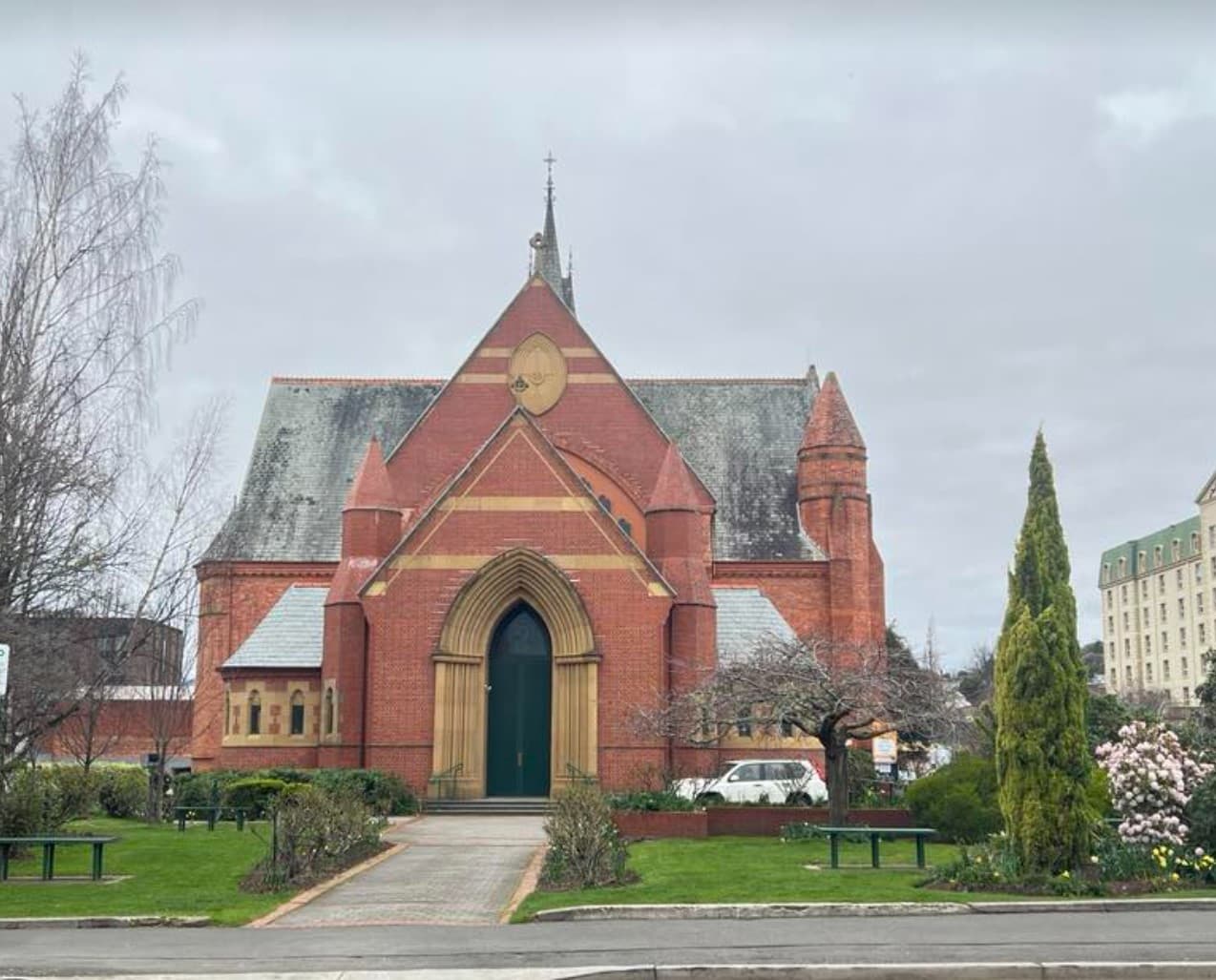
Holy Trinity (Trinity Church), was erected in 1841. The building was first opened for use in December 1842 and formally licensed in February 1845. Yet it was not until April 1850 that the church was consecrated, marking its full dedication to ecclesiastical service.
In the chronical of architectural evolution, the genesis of Holy Trinity Church traces back to a predecessor situated west of the present edifice, nestled within the verdant expanse of what now comprises the church gardens. Designed by the skilled hand of convict architect James Blackburn, this Gothic marvel, unfortunately, succumbed to the exigencies of faulty foundations, prompting its lamentable demolition in the late 1890s. As five decades of service rendered Holy Trinity Church unstable, the decision was made to embark upon the construction of a new sanctuary.
Under the astute guidance of Launceston architect Alexander North, and the skilled craftsmanship of Messrs. J. & T. Gunn, the vision for the new church materialized into brick and stone, with Sylvanus Wilmot, a distinguished Launceston stonemason, meticulously carving the intricate stonework. The ceremonial laying of the foundation stone on the 9th of February 1898, presided over by Charles Kent Esquire M.L.C., heralded the commencement of a new chapter in Holy Trinity's legacy, culminating in its consecration by Bishop Montgomery on the 4th of December 1902.
Contributing to the resplendent interior, Hugh Cunningham and his pupil Gordon Cummings, both esteemed artisans of Launceston, lent their talents to crafting exquisite wood carvings, showcasing their mastery within the sacred confines of the church. Cunningham's workshop, nestled in Paterson Street, served as the crucible for these fine creations, enriching the ambiance of Holy Trinity with their artistry.
Listed on the Tasmanian Heritage Register, Holy Trinity Church stands as a testament to the architectural prowess of Alexander North, epitomizing the Federation Gothic style with its brick structure adorned with sandstone accents. Its historical significance is further underscored by its role in accommodating the burgeoning population of Launceston in the 19th century, necessitating the establishment of another place of worship alongside St. John's.
The architectural evolution of Holy Trinity witnessed a transition from James Blackburn's colonial design to Alexander North's ambitious Gothic interpretation, marked by the ceremonial grandeur of its west front on George Street. Despite budgetary constraints, the east end comprising chancel, transepts, and vestries materialized under North's architectural vision, signaling a new era in Holy Trinity's architectural narrative.
The church's musical heritage is embodied in its organ, originating from an 1854 instrument crafted by Henry Bevington of London. Substantially rebuilt by George Fincham of Melbourne in 1887, this musical centerpiece echoes with the harmonies of centuries past, resonating within the sacred precincts of Holy Trinity Church, a testament to its enduring legacy.
We would like to extend our sincere thanks to Bishop Richard Condie for us granting permission to photograph and publish church licenses, maps, and other documents on our website.
NOTE OF INTEREST
In August 2005, Holy Trinity Church was the recipient a Tasmanian Community fund grant of $47,753 - The church, listed on the Tasmanian Heritage Register, is considered to be the greatest work of architect Alexander North and is a significant tourist attraction. Professional practitioners will be employed to carry out restoration of timber flooring, replacement of carpet, installation of interior glass doors and installation of awnings.
History
1841
Holy Trinity Church erected
builtDecember 1842
Church first opened for use
openedFebruary 1845
Church formally licensed
openedApril 1850
Church consecrated
consecrated1854
Organ originally crafted by Henry Bevington of London
built1887
Organ substantially rebuilt by George Fincham of Melbourne
rebuiltlate 1890s
Earlier church demolished
demolished1898-02-09
Foundation stone laid for new church
built1902-12-04
New church consecrated by Bishop Montgomery
consecratedAugust 2005
Church received Tasmanian Community Fund grant for restoration works
Gallery
References
- Tasmanian Heritage Council, THR #3924, our thanks to the THC.Tasmanian Pictorial Church Index
- J G Branagan, History of Holy Trinity Church Launceston 1842-1989, Launceston, Tas, Regal 1990Tasmanian Pictorial Church Index
- The Weekly Courier newspaper, 13 Dec 1902, pp 1220 &1221, photographer GrattanTasmanian Pictorial Church Index
- The Examiner newspaper 23 Aug 2005, p. 8Tasmanian Pictorial Church Index
- Ian Boersma, Launceston's historic churches and organs tour, 2021Tasmanian Pictorial Church Index
- D Henslowe, Our Heritage of Anglican Churches in Tasmania, Printed by Mercury-Walsh, Moonah, 1978, p. 40Tasmanian Pictorial Church Index
- QVMAG Collection, QVM:1983:P:2708Tasmanian Pictorial Church Index
- Anglican Church Licenses, NS3613-1-1, Tasmanian ArchivesTasmanian Pictorial Church Index
Links
- Holy Trinity Launceston website
Tasmanian Pictorial Church Index
- Tasmanian Archives, LPIC147/2/201, Launceston Collection of Photographs of Places etc
Tasmanian Pictorial Church Index
- Our History / A designer to the divine
Tasmanian Pictorial Church Index
- Holy Trinity, Church of England, Launceston, Tasmania, Marriage Register Index, 1900-1925
Tasmanian Pictorial Church Index
- New Church (1839, August 17). The Cornwall Chronicle (Launceston, Tas.: 1835 - 1880), p.2. Retrieved December 02, 2020
Tasmanian Pictorial Church Index
Services
Still in use
Open
Not recorded
Address
34 Cameron Street, Launceston TAS 7250
Contact
Not recorded
Accessibility
Not recorded