St George's
Sorell, Tasmania
The origins of St George’s Church reach back to the earliest years of settlement at Pittwater, later known as Sorell. Farming began in 1808, and by 1820 the Reverend Robert Knopwood...
- Denomination
- Anglican
- Region
- South
- Year Built
- 1821
- Architectural Style
- Church
- Heritage Status
- Heritage listed
Overview
The origins of St George’s Church reach back to the earliest years of settlement at Pittwater, later known as Sorell. Farming began in 1808, and by 1820 the Reverend Robert Knopwood conducted the first recorded service in a barn, attended by settlers, convicts, and children.
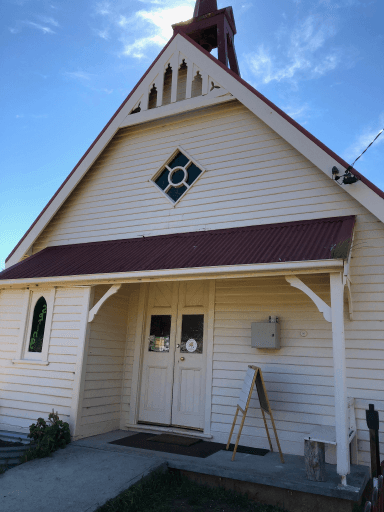
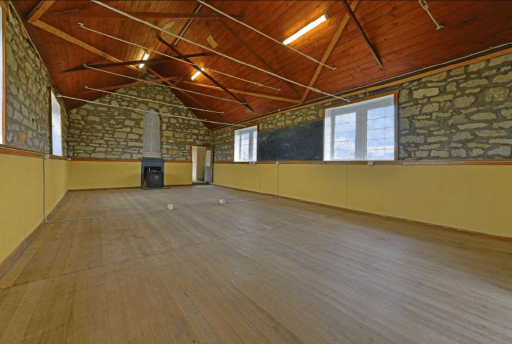
In 1821 a small timber rectangular building was erected it was quickly repurposed as a schoolhouse and church. Meanwhile, burials continued to be carried to Hobart until 7 March 1823, when Reverend Samuel Marsden consecrated land at Sorell as a cemetery under the authority of the Archbishop of Canterbury. The following month Knopwood retired to Clarence Plains, though he remained devoted to the church.
The Sydney Gazette and New South Wales Advertiser of the 22nd March 1822 reported the following:
... Feb 2 - On Tuesday last, in the afternoon, the Rev Mr. Knopwood performed Divine Service in the New Building, erected as a temporary place of worship, and permanently for the District School, at Sorell Township , Pitt Water ...
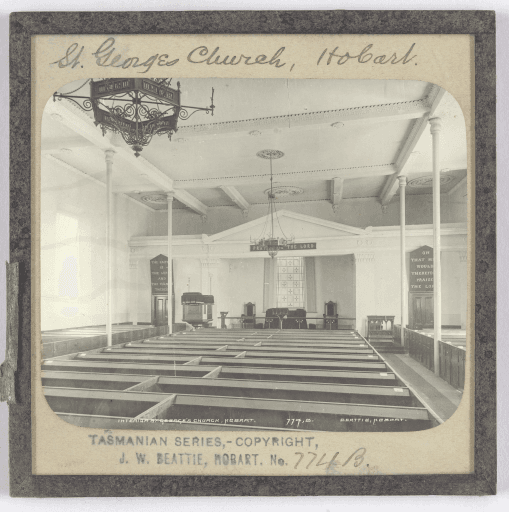
By 1826, concerns about the safety of the timber structure led Reverend William Garrard to call for a new church. Built largely by convict labour and completed in 1827, the stone building cost £1,450 and was designed to seat 600, with galleries on three sides for convicts on muster days. James Gordon of Forcett House and Captain W.H. Glover of Horsecroft served as the first wardens, and Gordon and his wife were later buried in the churchyard. Garrard departed in 1832, succeeded by Reverend James Norman, who ministered faithfully for thirty-five years.
On 7th May 1828, St George’s Church at Sorell was formally consecrated, marking a significant milestone in the religious life of the district. The ceremony was conducted by the Venerable Archdeacon Thomas Hobbes Scott, Clerk, Master of Arts, and Archdeacon of New South Wales, acting as Commissary under the authority of the Lord Bishop of Calcutta.
The event was witnessed by Lieutenant-Governor George Arthur, whose administration oversaw much of Tasmania’s early ecclesiastical development. Present also were Reverend William Garrard, chaplain of Sorell, Reverend William Bedford of Hobart Town, and the parish’s first churchwardens, James Gordon of Forcett House and Captain W.H. Glover of Horsecroft, Sorell.
The church endured until 1879, when it was declared unsafe. The Presbyterians graciously offered their building until a new Anglican church was raised on the same site in 1884, this time seating 215. Reverend C.J. Brammell oversaw the parish, travelling widely to conduct services across the district, before resigning in 1894 after twenty-six years.
The foundation stone of the new St George’s was laid on 23 October 1883 by Bishop Sandford, assisted by Brammell, Canon Mason, and Mr Woolnough, who had walked from Bellerive to attend. The ceremony began with the 100th Psalm, after which the bishop, standing upon the stone, delivered an address on the words “Do all in the name of the Lord Jesus.” At its close, forty pounds was laid upon the stone, marking the beginning of a new chapter in the life of St George’s Church at Sorell.
This church and burial ground is listed on the Tasmanian Heritage Register as follows:
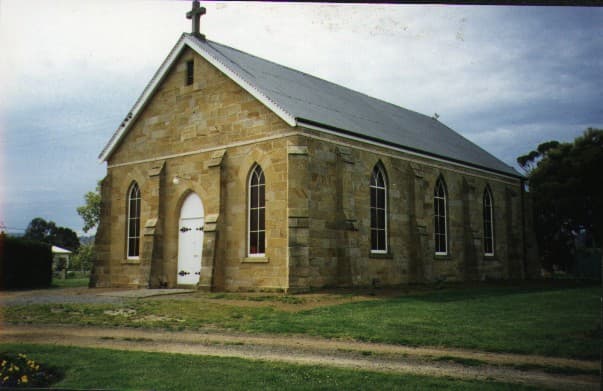
*An ashlar sandstone church with a rectangular ground-plan, corrugated iron gabled roof, dentilated bargeboards, close
boxed eaves, and buttresses. All the openings are pointed-arched. The door is in the centre of the west wall, with one
window to either side. There are three similar windows to the nave. The burials in the graveyard date from the 1830s.*
This church is still in use today.
History
1820
first recorded service in a barn at Sorell
founded1821
small timber rectangular building erected and used as schoolhouse and church
built1823-03-07
cemetery land consecrated at Sorell
1827
stone church built largely by convict labour
built1828-05-07
St George’s Church at Sorell formally consecrated
consecrated1830s
church and burial ground listed on the Tasmanian Heritage Register
heritage listed1879
church declared unsafe
closed1883-10-23
foundation stone of the new St George’s laid
built1884
reopened as the new Anglican church seating 215
renovated1884
new Anglican church raised on the same site
built
Gallery
References
- Paul Richard Davies. Sorell Heritage Survey: Site Inventory. Sorell, 1997Tasmanian Pictorial Church Index
- D Henslowe, Our Heritage of Anglican Churches in Tasmania, Printed by Mercury-Walsh, Moonah, 1978, p. 59Tasmanian Pictorial Church Index
- The Tasmanian Mail newspaper, 01 Jul 1915, p.24, photographer unknownTasmanian Pictorial Church Index
- Tasmanian Heritage Register No. 5358Tasmanian Pictorial Church Index
- Anglican Church Licenses, NS3613/1/1, p. 318 , Tasmanian ArchivesTasmanian Pictorial Church Index
- The Tasmanian Mail newspaper, 25 Dec 1909, p. 24, photographer unknownTasmanian Pictorial Church Index
Links
- Hobart Town Intelligence (1822, March 22). The Sydney and New South Wales Advertister (NSW: 1803 - 1842), p. 3. Retrieved December 28, 2019
Tasmanian Pictorial Church Index
- Albert Archer Rollings photographer, NS1553/1/143, Tasmanian Archives
Tasmanian Pictorial Church Index
- Sorell: 200 years on
Tasmanian Pictorial Church Index
Services
Still in use
Open
Not recorded
Address
16 Gordon Street, Sorell TAS 7172
Contact
Not recorded
Accessibility
Not recorded